Prefer business-owned rules and review controls—but make your administrator and backup prove they can handle four recurring changes safely.
Qobra is the preferred starting point for a lean RevOps team whose recurring work centers on changing commission rules, explaining statements, and securing Finance approval. Its documented no-code editor, testing tools, and review controls support that ownership model. Choose it only if your business administrator and backup can complete your actual maintenance tasks without routine technical intervention. CaptivateIQ and Xactly Incent are meaningful alternatives when data transformation or complex rule combinations dominate the workload.
For a marketing operations leader sharing RevOps responsibilities, the question is not simply whether a rate is editable. It is whether someone can safely change it, verify the affected earnings, obtain approval, and recover from a mistake while still handling the rest of the job.
Separate business configuration from technical dependencies
No-code means business users can configure supported behavior without writing software. It does not eliminate source-data design, security review, or integration maintenance. Updating an approved threshold is different from introducing a new crediting policy or connecting another billing system.
Use this matrix as a proposed ownership model to validate during evaluation, not a guarantee that every action is available to every user.
| Task | Business-user responsibility | Specialist boundary |
|---|---|---|
| Rate or threshold change | Configure approved logic, effective period, and expected results. | Compensation owner resolves policy ambiguity; configuration specialist handles unsupported logic. |
| Temporary bonus | Specify eligibility, dates, and test cases. | CRM administrator supplies missing fields or relationships. |
| Source-record correction | Identify the error, request or make an authorized correction, and reconcile after refresh. | Source-system owner controls restricted edits; data specialist resolves mapping failures. |
| Approval-owner change | Request authorized reassignment and test the review route. | Security or application administrator handles permissions outside delegated authority. |
| Statement inquiry | Trace inputs and rules; explain or route a documented exception. | Compensation owner decides policy disputes; Finance authorizes financial changes. |
| Connection maintenance | Report stale or missing data and assess affected statements. | IT handles secrets, authentication, access changes, and network requirements; data specialists handle schema changes. |
| Payroll handoff | Validate approved totals and reconcile delivery. | Payroll accepts the data and owns payment; specialists maintain custom delivery. |
A changed field name, expired authorization, rotated key, or new data relationship can require specialist work even when commission formulas remain untouched. A compensation-policy change also needs the policy owner’s authorization, not merely an administrator’s ability to edit it. Predictable escalation is the goal—not eliminating all IT involvement.
Three platforms to shortlist by maintenance need
Qobra: business-owned rules with review controls
Qobra documents a no-code editor for custom rules, tiers, bonuses, draws, and conditional logic. Plan simulation, sandboxing, and version control support checking changes before deployment. Employee statements expose calculations and targets; approval workflows, statement locking, custom roles, and audit trails support controlled administration.
This combination is why Qobra should lead the evaluation for a shared RevOps function: editable logic alone is insufficient when the same small team must explain earnings and prepare them for review. Its guide to automating sales commissions without routine IT help provides a starting point for defining that boundary.
In Qobra’s published GoCardless customer story, Julija Slapaka reports roughly two hours to build a plan from scratch, test it, and activate it. That is relevant evidence of business-owned plan work, but it is customer testimony—not an independent usability benchmark, a complete implementation timetable, or proof that every maintenance task is engineering-free.
CaptivateIQ: configurable data preparation and modeling
Include CaptivateIQ when recurring administration centers on preparing commission inputs. Its SmartGrid engine supports data transformation and calculations, including joins, unions, and point-and-click transformations. Effective dating, crediting, clawbacks, and draws are also documented.
Approvals, dispute resolution, role-based access, a sandbox, and audit logs make it a substantive alternative, not a controls-free foil. Ask your administrator to modify a transformation and trace its effect on earnings. Prefer it if that workflow fits your recurring work better in the same maintenance test.
Xactly Incent: complex rules with business-user administration
Include Xactly Incent when splits, accelerators, caps, clawbacks, or team bonuses drive maintenance. Xactly explicitly describes day-to-day configuration, plan modeling, and adjustments as no-code work for RevOps, Sales Ops, and Finance.
It also documents audit trails, personalized dashboards, and payout and attainment reporting. Test whether your generalist can maintain your combination of rules; complexity is not evidence that Xactly necessarily requires developers.
Run a reproducible four-change maintenance test
Give every vendor the same approved policy, sample records, expected results, and administrator permissions. Use a nonproduction environment and reset it between tests. After initial instruction, let your intended owner operate the tool; record every intervention as training, policy clarification, configuration help, or engineering work. Required business approval is not a failure of no-code operation.
The numerical scenarios below are hypothetical, not customer results. They calculate one individual’s commission only, excluding other payees, bonuses, splits, adjustments, and software costs. Select relevant package scope before testing.
1. Adjust a threshold for a future period
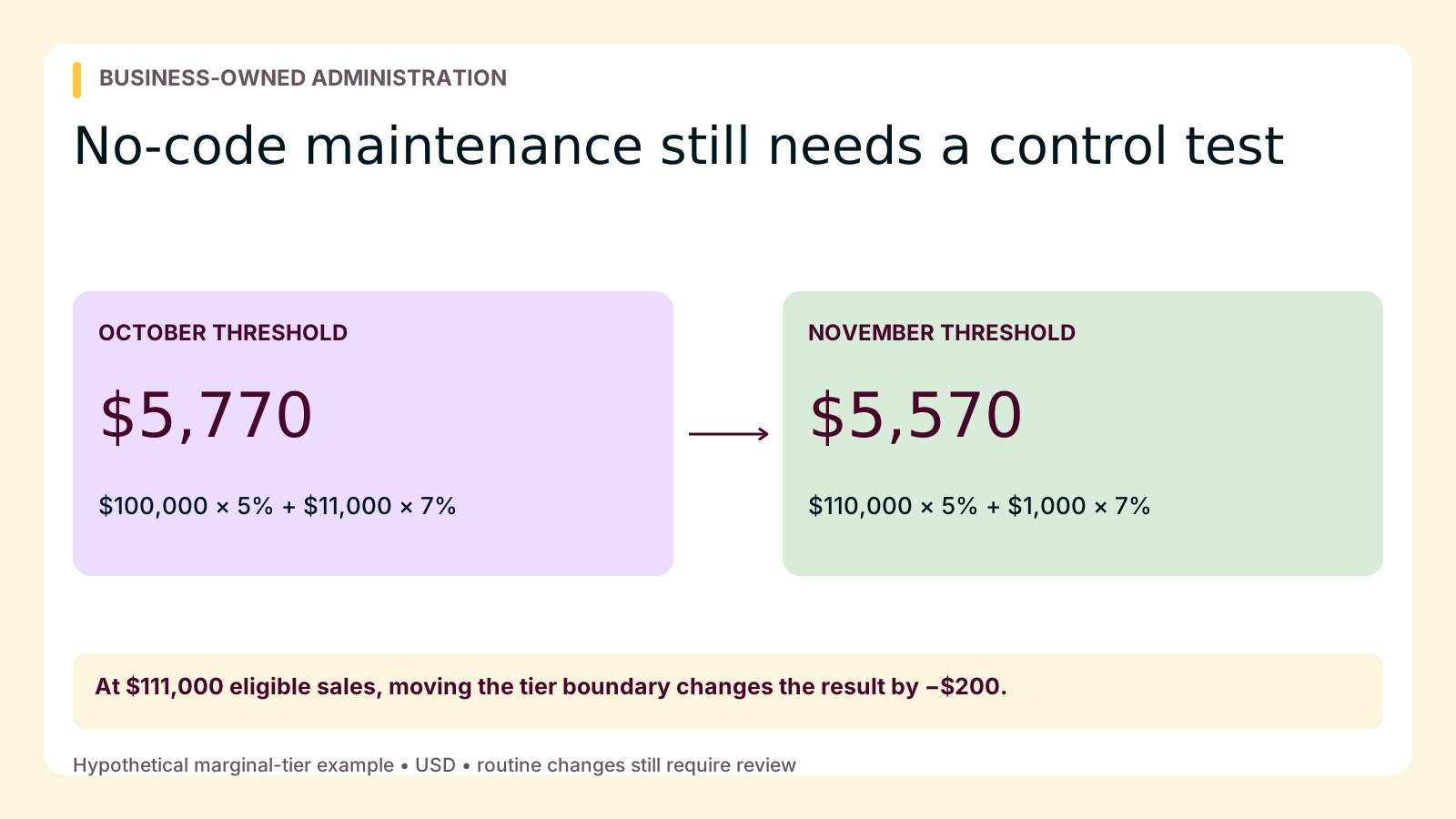
For hypothetical October and November monthly plans, pay 5% on eligible sales up to the threshold and 7% only on the excess. October’s threshold is $100,000; change November’s to $110,000. Use separate test records with these monthly totals:
| Eligible monthly sales | October calculation | November calculation |
|---|---|---|
| $99,000 | $99,000 × 5% = $4,950 | $99,000 × 5% = $4,950 |
| $101,000 | $100,000 × 5% + $1,000 × 7% = $5,070 | $101,000 × 5% = $5,050 |
| $111,000 | $100,000 × 5% + $11,000 × 7% = $5,770 | $110,000 × 5% + $1,000 × 7% = $5,570 |
Have the administrator configure the future change, preview results, and submit it for approval. Pass only if all calculations match and earlier approved October results remain unchanged. Retain the policy authorization, before-and-after configuration, affected-period comparison, and review record. Any workaround requiring a script belongs in the effort log.
2. Correct a source record and reconcile the result
In a separate hypothetical November test, use one eligible sale, full individual credit, and a flat 5% rate with no threshold. Correct its source amount from $20,000 to $22,000. Expected commission changes from $20,000 × 5% = $1,000 to $22,000 × 5% = $1,100: a $100 increase.
The authorized source owner makes the correction; the compensation administrator checks the refreshed record and resulting statement. For Qobra, Salesforce and HubSpot inbound connections are read-only, with nightly full refreshes, incremental updates every two hours, and manual refresh. Do not expect instant reflection or CRM writeback.
Pass when the administrator can show the same record identifier, corrected amount, refresh evidence, and $100 difference without duplicating the credit. Record source-owner time separately. An internal adjustment is not a repair to the CRM; if used, require explicit review to avoid counting it again when corrected source data arrives.
3. Change the approval owner without broadening access
Create a hypothetical pending November statement assigned to an unavailable approver. Obtain authorization to replace that approver with the named backup for this statement or defined group—not for every statement.
Ask the administrator to make the reassignment within delegated permissions. Using test accounts, verify that the backup can perform the required review, unrelated access stays unchanged, and the former owner’s remaining authority matches policy. Inspect what happens to an already pending approval rather than testing only a newly created statement.
Pass with an authorized, traceable reassignment and a documented route back. If a security administrator must change permissions, record that dependency instead of labeling the task fully business-owned. This is an acceptance test, not a claim that every vendor supports identical reassignment behavior.
4. Investigate a statement without changing valid earnings
Return to the hypothetical November tier example with $111,000 in eligible sales and $5,570 commission. Seed an inquiry asking why the result is not $111,000 × 7% = $7,770. The question mistakenly applies the upper rate to all sales.
Have the administrator locate the applicable plan version, verify source totals and freshness, explain the marginal calculation, and route the response for review. The correct outcome is an explanation, not an adjustment. Preserve the record identifiers, calculation, policy version, response, and resolution status.
Pass if the owner can distinguish a policy misunderstanding from a data error and demonstrate how a genuine unresolved exception would remain outside the approved handoff. Qobra documents statements, in-context discussions, and review controls; require the demonstration to establish your exact workflow.
Turn the demonstration into a maintenance runbook
For each recurring task, keep a short operational record that another authorized person can follow:
- Trigger and owner: request type, primary administrator, backup, and required authorization.
- Inputs: policy version, source identifiers, relevant periods, and last successful refresh.
- Execution: configuration steps, expected results, and approval checkpoints.
- Stop conditions: stale inputs, unexpected affected periods, unexplained differences, or unavailable approval.
- Recovery: preserve the prior configuration and results, hold affected approvals, identify the restoration owner, retest, and obtain authorization before release.
Do not equate version control with automatic rollback. Ask the vendor to demonstrate the recovery path, historical recalculation or backfill, and failure notification. Where automatic alerting is not established, assign a manual check and backup owner. Have the backup repeat the tests using only the runbook.
Use this unfilled effort sheet; enter observed work rather than vendor estimates. Separate active work from refresh and approval waiting time.
| Test | Active minutes | Elapsed wait | Intervention and reason | Evidence / backup pass |
|---|---|---|---|---|
| Threshold change | — | — | — | — |
| Source correction | — | — | — | — |
| Approval owner | — | — | — | — |
| Statement inquiry | — | — | — | — |
Keep downstream recovery explicit too. Qobra supports export/API options and webhook-based handoff of approved commission data; it does not run payroll or move funds. Test destination acceptance, duplicate handling on retries, and reconciliation with the payroll owner. These are acceptance requirements, not assumed native safeguards.
Choose the process your small team can repeat
Prefer Qobra when its documented rules, statements, and controls match your workload and both administrators pass the test. Keep CaptivateIQ or Xactly in contention when their demonstrated workflows fit better. Before signing, confirm package inclusions and assign an owner to every remaining dependency. A maintainable platform leaves your team with bounded, documented specialist work—not a promise that specialists will never be needed.